
Back to Course List
Plastics: 2-Plate, 3-Plate, and Hot Runner Molds
- Product ID
- ardsmd04
- Training Time ?
- 69 to 138 minutes
- Language(s)
- English
- Video Format
- Standard Definition
- Required Plugins
- MasteryNet Player
- Lesson Interactions
- 63
- Quiz Questions
- 50

Overview
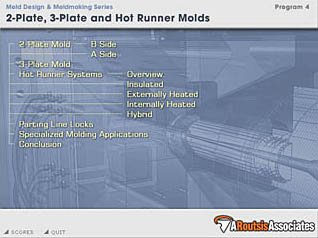
Training Program 4 of the 9-part Mold Design and Moldmaking series was created with help from many of the world’s leading tool manufacturers and suppliers. The 2-Plate, 3-Plate, and Hot Runner Molds course explains the three basic mold designs and their construction; discusses the advantage and disadvantage of each design and lists their common uses. The training also explains different hot runner systems, parting line locks, and specialty molds.
 This course is in the Advantage™ format, to read about Advantage™ features click here.

- Rich multimedia presentation with interactions and quiz
- Print certificate and wallet card
- You have 30 days to complete the course
Workplaces
Audience
Any worker who is or who is training to be a tool designer, mold maker, engineer, part designer, or anyone involved in the tool procurement process.
Topics
The course presents the following topical areas:
- 2-Plate Mold (B Side)
- 2-Plate Mold (A Side)
- 3-Plate Mold
- Overview of Hot Runner Systems
- Insulated Hot Runner Systems
- Externally Heated Hot Runner Systems
- Internally Heated Hot Runner Systems
- Hybrid Hot Runner Systems
- Parting Line Locks
- Specialized Molding Applications
Intended Performance Outcomes
Upon successful completion of this course you will be better prepared to:
-
- Agree that the 2-plate mold is the most common mold design.
- Explain that this mold uses a cold runner system to transfer the material.
- Recall that the clamp plate is either bolted or clamped to the movable platen.
-
- Choose the rout of the leader pins.
- Identify how the locating ring is bolted to the clamp plate.
-
Know the advantages gained by using a 3-plate mold configuration.
- Recall that the 3-plate mold uses a floating center plate.
- Agree that the B half does not contain a sprue puller.
- Explain that the cavities must be 'top' gated.
-
Know that hot runner systems are constantly in direct contact with the nozzle.
- Recall that hot runners remain heated during part cooling.
- Choose to stay in the mold during part removal.
- Explain that most applications will notice a decrease in cycle time.
-
Understand the advantages and disadvantages of the insulated hot runner system.
- Choose the insulated hot runner system as the simplest form of hot runner.
- Recall that insulated hot runner systems use an additional plate.
- Select the insulated hot runner system as recommended for low temperature polymers.
-
Understand the advantages of the externally heated hot runner system.
- Identify the most common hot runner system.
- List the runner channels machined through the manifold.
- Choose the item used to measure the temperature of the manifold.
-
Understand the advantages of the internally heated hot runner system.
- Explain how the nternally heated hot runner system uses heating elements in the center of the tubular runner channel.
- Identify four different ways to implement the internally heated hot runner system.
-
Understand the advantages or disadvantages of hybrid hot runner systems.
- Recall that hybrid hot runner systems are made from a combination of hot runner technologies.
- Agree that heated drops can be added to an insulated hot runner mold.
-
Know how to properly align the parting line during mold closing.
- List the three most common parting lines.
- Agree that parting line locks help prevent damage to the parting lines.
- Choose to align the parting line during mold closing.
-
Recognize some of the specialized forms of tooling introduced to the industry.
- List various specialized forms of tooling.
© Mastery Technologies, Inc.
