
Back to Course List
Plastics: Part Ejection, Venting, and Cooling

- Product ID
- ardsmd07
- Training Time ?
- 70 to 140 minutes
- Language(s)
- English
- Video Format
- Standard Definition
- Required Plugins
- MasteryNet Player
- Lesson Interactions
- 58
- Quiz Questions
- 41


Overview
The seventh training program in the 9-Part Mold Design and Moldmaking Training series, created with help from many of the world’s leading tool manufacturers and suppliers, trains the learner to work with ejector pins, sleeves, blades, and lifters; stripper plates and pneumatic ejection; water lines, bubblers, baffles, and conductive cooling rods; multi-stage ejection and ejection return; and different forms of part venting.
 This course is in the Advantage™ format, to read about Advantage™ features click here.
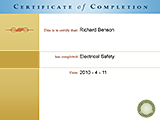
- Rich multimedia presentation with interactions and quiz
- Print certificate and wallet card
- You have 30 days to complete the course
Workplaces
Audience
Any worker who is or who is training to be a tool designer, mold maker, engineer, part designer, or anyone involved in the tool procurement process.
Topics
The course presents the following topical areas:
- Ejector Pins
- Ejector Sleeves
- Ejector Blades
- Lifters
- Stripper Plates
- Air Poppet Valves
- Two-Stage Ejection
- Positive Ejection Return
- Venting
- Part Cooling
- Cooling Example
- Core and Cavity Cooling
- Complex Cooling
- Pulse Cooling
Intended Performance Outcomes
Upon successful completion of this course you will be better prepared to:
-
Know the design and uses of ejecting parts using ejector pins.
- Name one of the four major functions a mold must perform.
- Recall that a uniform ejection force must be applied to the part.
- Select the most common form of part ejection.
-
Know the design and uses of ejecting parts using ejector sleeves.
- Locate where sleeves are mounted.
-
Know the design and uses of ejecting parts using ejector blades.
- Explain the use of wide, rectangular blades.
- Recall that ejector blades are often used in place of ejector pins.
-
Know the design and uses of ejecting parts using lifters.
- List the lifters used to distribute the ejection force.
- Agree that lifter guides should be inserted.
-
Know the design and uses of ejecting parts using stripper plates.
- Explain how to remove the part.
- State the location where a uniform ejection force is applied.
-
Know the design and uses of ejecting parts using air poppet valves.
- Recall that air poppet valves supply air to the top of the core.
- Choose valves uses.
-
Know the design and uses of ejecting parts using lifters as an internal action.
- List uses of lifters as an internal action.
-
Understand how to eject parts when a single-stage ejection system is inadequate.
- Explain the need to fully retract the ejection system before the mold.
- List five common methods of positive ejection return used in the industry.
-
Know how to ensure that the ejection system is retracted before mold closing.
- Recall that proper venting can significantly reduce warpage and distortion.
- Name the most common place to vent.
-
Understand how to significantly reduce part warpage and distortion.
- Recognize the objective is to cool the part as quickly and as evenly as possible.
- Select the kind of fluid.
-
Understand that parts should be cooled as quickly and as evenly as possible.
- Choose examples of cooling.
- Identify different scenarios that dictate cooling line layouts.
-
Recognize that a cooling line layout must consider multiple variables.
- Agree that cores and cavities can be cooled using alternative methods.
- List types of cooling.
-
Recognize that cores and cavities can be cooled using alternative methods.
- List alternative methods of cooling.
-
Recognize complex cooling methods such as baffles, bubblers, and thermal pins.
- Agree that complex cooling is used to establish and hold a consistent mold surface temperature.
- Recall that these systems use mold temperature sensors located near the cavity.
- Understand how to establish and hold a consistent mold surface temperature.
© Mastery Technologies, Inc.
